
A pharmacy bottle holds more information than most families realize. The label was designed to summarize a prescription for the patient who would take it — back when most patients only took one medication and could read small print. For a family caregiver managing eight bottles for an eighty-five-year-old parent, the label deserves a careful re-read.
This guide is a plain-language tour of what is on a U.S. pharmacy bottle: the drug name and strength, the dosing instructions, the prescriber, the refill window, the warning stickers, and the small codes that tell you whether this bottle is the same medication as the one in last month's bottle.
TL;DR: The big print on a pharmacy bottle tells you what the drug is and how to take it. The small print tells you who prescribed it, when it was filled, how many refills are left, and the National Drug Code (NDC) that uniquely identifies the exact product. Warning stickers are added by the pharmacy and are worth reading every time — they often flag the interactions that matter most. If anything on the bottle changes between refills, ask the pharmacist before opening it.
The top of the label
The largest print on the label is the medication itself. There are usually two names: the brand name (capitalized, often in the largest font) and the generic name (in parentheses or below). The generic name is the one the rest of the medical system uses — when the hospital, the specialist, or the home-health nurse asks 'what is she on?', the generic name is the most universal. Write both names in the master list.
Just below the name is the strength — 'tablet 10 mg' or 'capsule 500 mg' or 'suspension 100 mg/5 mL.' This is one of the two most-confused fields on a bottle, because the same medication can come in many strengths and a 'metformin' bottle alone tells you almost nothing. The other most-confused field is the dosing instruction. Read both together; never read one without the other.
The dosing instructions
'Take one tablet by mouth twice daily.' This is typically how dosing instructions are written. The pharmacy printed it from the prescriber's instructions, sometimes with small edits for clarity. The fields worth reading carefully every time: how much (one tablet, half a tablet, two), how (by mouth, under the tongue, with food, on empty stomach), how often (twice daily, every twelve hours, every morning), and any special timing notes (separate from calcium by two hours, take with the largest meal of the day).
- Watch out for "as needed""Take one tablet as needed for pain" or "as needed for sleep" looks like a routine but is not. The patient decides whether to take it. Worth tracking how often "as needed" actually means "every day."
- Watch for "at bedtime"Often abbreviated as "qhs" in some prescriber notes; the bottle should spell it out. A bedtime medication taken in the morning could decrease its benefit and sometimes causes harm.
- Watch for "with food" vs. "empty stomach"Some medications need food to absorb correctly; others need an empty stomach. The pharmacist will tell you which it is for each bottle — write it on the master list.
- Watch for "do not crush"Some pills are designed to release over hours and lose that property if crushed or chewed. The warning sticker is usually red.
- Watch for "may cause drowsiness"Common, often ignored, and often the reason an older parent is having more falls or new daytime sleepiness. Worth flagging in the master list and to the doctor.
- Watch for "do not take with alcohol"The interaction can be significant. Worth asking the pharmacist what counts — for some medications it really does include the half-glass of wine at dinner.
The middle of the label: who, when, how many
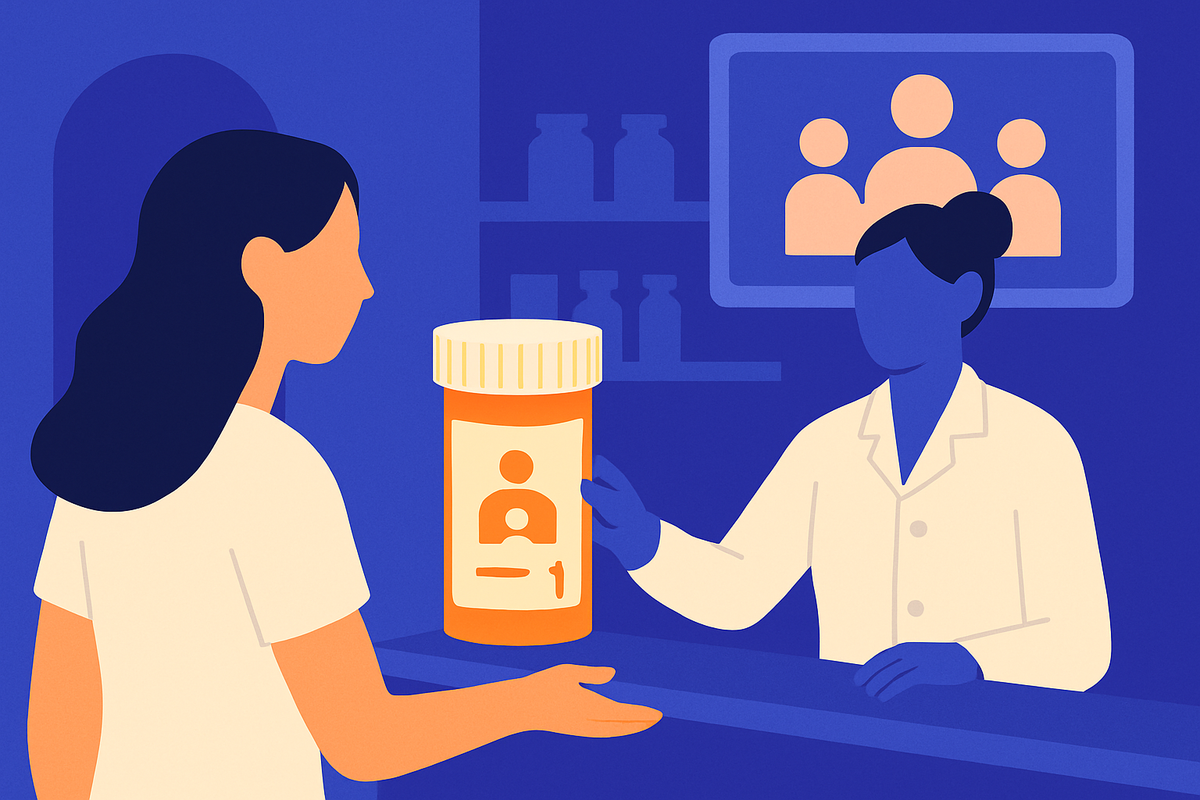
Below the dosing instruction is the practical block — the prescriber's name, the fill date, the quantity dispensed, the number of refills remaining, the lot number, and an expiration date. The fields a family uses most often are the prescriber (so you know who to call with a question), the refill count (so you do not run out on a Sunday), and the fill date (so you can see whether the bottle is from this month or last year).
The refill block usually reads 'Refills: 2' or 'Refills remaining: 2 before [date].' When the count is zero or near zero, the family should call the prescriber's office at least a week before the bottle runs out — refills sometimes take a few days, especially for controlled substances. Some pharmacies will text or email when refills are running low, but the family list should also track refill timing.
The small print: NDC, lot, and expiration
The National Drug Code (NDC) is the eleven-digit number, usually on the side of the label, that uniquely identifies the exact medication product — manufacturer, strength, package size. If the NDC changes between refills, the bottle may look different (different shape, different color, different markings on the pill itself) without the medication itself changing. That is usually a generic-manufacturer switch and is generally fine — but it is worth confirming with the pharmacist so the family does not assume an error has happened.
The lot number and expiration date are usually printed near the NDC. The expiration date is worth being aware of, particularly for medications that come out of the bottle only as needed (nitroglycerin, EpiPens, insulin, asthma rescue inhalers). Track and replace medications before expiration.
The warning stickers
Every pharmacy adds colored stickers around the main label — 'May cause drowsiness,' 'Take with food,' 'Do not crush,' 'Avoid grapefruit,' 'May cause sun sensitivity.' These are not legally required and the exact set differs between pharmacies, but they capture the warnings the pharmacist considered most important for that specific medication. Read every one, every refill — sometimes the pharmacist adds a sticker mid-cycle that was not on the previous bottle, because a new interaction warning has come out.
When something on the bottle changes
The bottle changes for a reason. Sometimes the reason is harmless (a different generic manufacturer; a different pharmacy chain; a packaging redesign). Sometimes the reason matters (a different strength; a different formulation, like extended-release vs. immediate-release; a different schedule). The rule of thumb: if anything on the bottle is different from last month — the pill itself, the strength, the schedule, the prescriber, the NDC — call the pharmacist before the parent takes the first dose.
A two-minute call to the pharmacy almost always resolves the question. The pharmacist can pull both prescriptions, confirm what changed and why, and tell the family whether the new bottle is equivalent to the old or genuinely different. Pharmacists are the most under-used resource in family medication management. They are paid to answer this exact call.
The label-reading habit is the gateway to the annual medication review. For the deeper piece on what an annual review actually looks like and who can run it, see The medication review every senior should get every year. The same habit is part of how a family catches a "prescribing cascade" — see What is polypharmacy — and why it's dangerous after 75. For the broader playbook this conversation feeds into, see The Caregiver's Guide to Managing Your Parent's Medications. For the longer pillar, the Medications hub has the full set.
A note on what helps: Aging Sidekick can help you turn the labels of every bottle on the counter into one clean printed list — built from a fifteen-minute voice intake or a few photos. We organize; doctors prescribe and pharmacists review. Always ask the pharmacist when something on the bottle changes — never change a medication regimen on your own.
Build your parent's medication plan
Aging Sidekick captures every prescription, OTC, and supplement your parent takes — voice intake or document upload — and gives you back a clean, shareable medication list with side-effect flags.
Start a medication planSee the medication-management walkthrough →