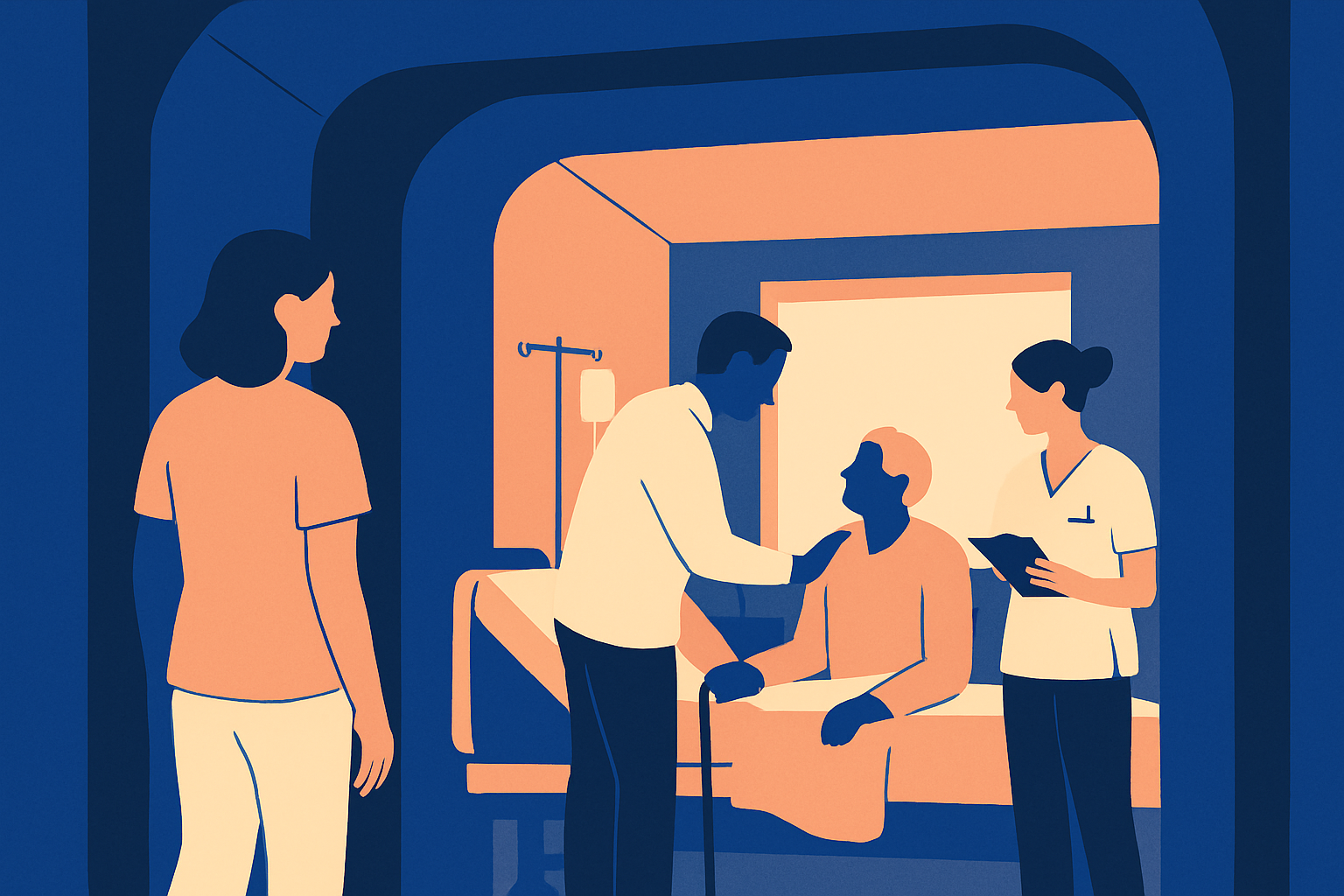
Hospital stays are typically less than 5 days, and the discharge date can be sudden. You might feel surprised or unprepared when you get a call that, "Your mom is ready to go home tomorrow." If you have been at the hospital for three days, you are exhausted. If you have just flown in, you are jet-lagged. Either way, the discharge clock has started, and the next 48 hours are key to ensuring your family member has what they need after they leave the hospital.
This guide is the 48-hour plan, in order. It walks through what to do before discharge, what to ask in the care plan meeting, how to read the paperwork, how to reconcile the medication list, how to set up the home for a safe return, and how to navigate the first two weeks — the window in which most readmissions happen. Plain language. No clinical jargon. Built from the questions caregivers ask after they realize the system is moving faster than they are.
TL;DR: The care plan meeting before discharge is when you confirm the diagnosis in plain English. Be prepared to attend the discharge or care plan meeting with a written list of questions, get a corrected medication list, line up equipment and follow-up appointments, and prepare the home. The first two weeks at home are where readmissions to the hospital are most likely — keep the after-hours nurse line in your phone, watch for warning signs specific to the diagnosis, and call early with concerns. You are not bothering anyone.
The 48 hours before discharge: what to do today
Discharge timing is planned carefully by the hospital. But it is often a surprise to the family. By the time a case manager mentions "going home soon," the team has usually been planning it for a day or two. You can make things easier by collaborating with the discharge team on the care needs after your loved one leaves the hospital.
Start with three phone calls and one folder. The phone calls are: the case manager (also called a discharge planner or social worker), the primary nurse on the floor, and whichever family member or friend can physically be at the hospital for the discharge meeting. The folder is a real, physical folder — a $0.50 manila folder beats any app on discharge day, because the staff often hand you paper with post-discharge information.
In that folder, you want four things by the time discharge happens: the discharge summary, a printed medication list (admission list plus what changed), follow-up appointment cards or printed instructions, and the after-hours nurse-line number. If anything is missing, ask before you leave the room. The single most common reason for readmission is medication errors. People often take the wrong medications because, "we did not realize they meant to stop the old pill."
If you have not already, take ten minutes to skim the hospital discharge intent page for the short version of this same plan — it's the printable, one-page companion to this article and links to a 15-minute voice walkthrough that produces a written discharge plan you can hand to the case manager.
The discharge meeting: questions every caregiver should ask
The discharge meeting is key to being prepared after your loved one leaves the hospital. It usually lasts twenty minutes. It almost always feels too fast. Going in with a written list — even a phone screen list — slows the room down, and slowing the room down is the goal.
Ask permission to record so that you can capture everything and review it later. If recording is refused, take written notes and read them back at the end of the meeting. Saying out loud, "let me make sure I understood you" helps you avoid the 2 a.m. phone call.
Here is the working list, in the order that tends to surface the most useful questions:
- What is the diagnosis, in everyday words?Ask for the translation of any medical term you do not recognize. Write it down. Ask again if it is still unclear.
- What changed during this stay?A new condition, a worsening of an old one, a new medication, a new device. Knowing the "why we are here" makes the rest of the plan make sense.
- Which medications are new, stopped, or changed?Ask for a printed list with name, dose, timing, and what each one is for. Compare it to what was at home.
- Who is the follow-up provider and when is the first visit?Aim to leave with that appointment on a calendar, not on a to-do list. If a specialist is needed, get the name and phone number.
- What equipment is coming home?Walker, oxygen, commode, hospital bed, wound-care supplies. Confirm delivery time, who pays, and who shows you how to use each item.
- What warning signs mean call the doctor, and what means call 911?Get both lists in writing, specific to this diagnosis. Confusion, fever, swelling, sudden pain, and trouble breathing are common categories — but ask for the diagnosis-specific ones too.
- Who do I call after hours?Save the nurse-line number in your phone before you leave the building. Late-night uncertainty is what readmissions are made of.
- What help do we qualify for at home?Home health, physical therapy, occupational therapy, a home-safety visit. Ask if any of it has already been ordered, and how to confirm.
For a longer printable version of the meeting questions — twelve in total, grouped by topic — see our companion post: Hospital discharge: 12 questions to ask before you leave.
The phrase “safe discharge” — is a real term of art in hospital discharge planning. If your honest answer to "can you do this at home tonight" is no, you can say so out loud. The hospital is focused on ensuring a safe transition. They can help you create a safe plan, so if you need more time, more help, or a different setting, ask them for options.
Reading the discharge summary line by line
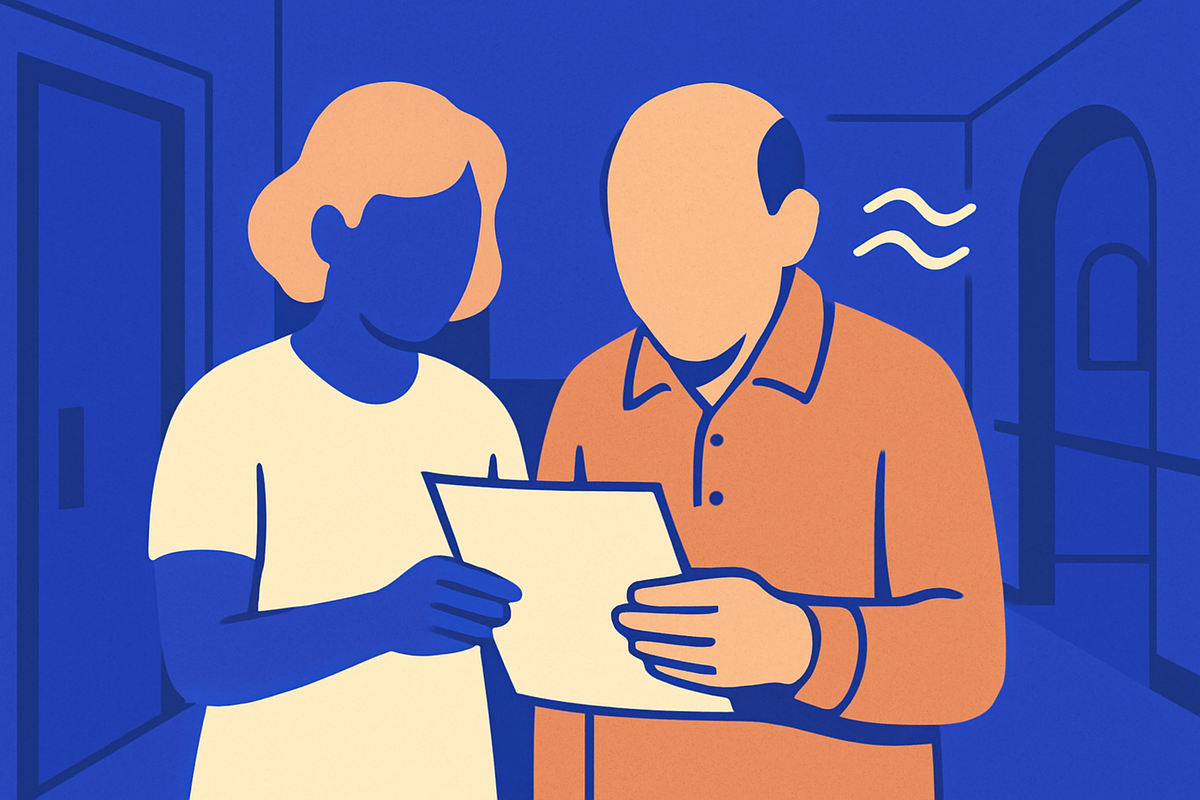
The discharge summary is the multi-page packet you get on the way out. Three out of four caregivers never read it past the first page, so they miss key information. Here is how to actually use it.
Start with the front-page sections: admission reason, hospital course, discharge diagnosis, discharge condition, and discharge instructions. Read each one out loud — literally out loud, even if you are alone. The act of reading aloud is what surfaces the words you do not understand. Circle any term you would not be able to explain to a friend. Those are the words to ask the case manager or the follow-up provider about.
Then look at the medication section. There is almost always a "reconciliation" table or list that names every medication, the dose, and whether it is new, continued, changed, or stopped. The most common cause of a readmission to the hospital is a medication taken at the wrong dose, at the wrong time, or twice — once from the new list and once from the old bottle in the cabinet. Match the list, line by line, to what is actually in the kitchen.
Look for the follow-up section near the back. It will name a primary provider, sometimes a specialist, and a window — "within seven days," "within two weeks." If the appointment has not been scheduled, ask before you leave the building. A note that says "patient to follow up" without a date is a note that often never becomes an appointment.
Finally, look for the warning-signs section. Hospitals call this "red flags" or "when to call." This is the page you tape to the refrigerator. If a sibling, a neighbor, or a home-health aide is going to be alone with your parent, this is the page they need too.
Medication reconciliation: getting the med list right
The phrase "medication reconciliation" sounds clinical, but the idea is simple: the list of pills your parent took before the hospital stay rarely matches the list they are sent home with, and the gap is where the trouble starts. The Agency for Healthcare Research and Quality (AHRQ) has found that medication errors are among the most common preventable causes of readmission in older adults.
Three failures account for most of these errors. The first is duplication: a hospital starts a new blood-pressure medication and the family keeps giving the old one, because the old one is in the pill organizer. The second is omission: a blood thinner gets paused for surgery and never restarted at home. The third is dose change: a familiar pill comes back at half the strength but in a bottle that looks the same.
The solution is small and physical. Before you leave the hospital, ask for the most recent printed medication list. At home, gather every bottle and box on the kitchen counter — including supplements, over-the-counter pain relievers, and anything in the bathroom cabinet. Match each bottle to the list. Anything on the list that is not on the counter, write down. Anything on the counter that is not on the list, write down. Take both lists to the pharmacy on the way home or to the first follow-up visit, and ask the pharmacist or nurse to walk through them.
A photograph of every pill bottle, taken in good light, is a useful backup. You can also use a tool like Aging Sidekick, which lets you photograph the bottles or upload the discharge summary and gets back a structured medication list with interactions flagged for a clinician to review. We are not a substitute for the pharmacist — but having the list in one place beats five sticky notes on the fridge. Aging Sidekick complements, not replaces, your healthcare team.
Setting up the home for safe return
The home that worked yesterday may not work tonight. A parent who left walking unaided may come home with a walker. A parent who was sleeping upstairs may need to sleep on the main floor for two weeks. The goal of the 48 hours before discharge is not a perfect home — it is a safe enough home for the first two weeks. Bigger projects can come later.
Walk the path your parent will actually take, in the order they will take it: from the car to the front door, from the entry to a chair, from the chair to the bathroom, from the bedroom to the kitchen. On that walk, you are looking for three things: trip hazards (loose rugs, cords, pet bowls), reach hazards (anything they will need that is too high or too low), and grip points (a wall to lean on, a sturdy chair to rest at, a railing on every step).
- Clear the path from bed to bathroomMove rugs, cords, magazines, and pet bowls. A clear, well-lit path at 2 a.m. is the single highest-yield change.
- Add a chair in the shower (or rent a bench)Showers are the highest-fall-risk activity at home. A bench plus a handheld shower head prevents most falls.
- Put a nightlight in the bathroom and hallwayA motion-sensor plug-in nightlight costs less than a copay and removes a real fall risk.
- Set up a "command station" on the main floorA small table with the medication list, the warning-signs page, the after-hours nurse line, and a phone within reach. One spot for everything.
- Confirm equipment delivery and walkthroughWalker, oxygen, hospital bed, commode — confirm the time and ask the delivery technician to show every adult in the home how to use it safely.
- Stock the kitchen for three daysSoft foods, hydration, anything the discharge instructions name. The first 72 hours is not the moment for a grocery run.
For longer guides on the bigger home-safety questions — bathrooms, lighting, stairs, and the larger conversation about whether the home is right for the long run — see our pillar overview at the Hospital Discharge guides hub. The home changes that prevent ER trips guide is the practical room-by-room companion, and aging in place safely covers the longer-term picture.
The first 24 hours at home

The first 24 hours are deceptively quiet. The discharge papers are signed, the car is unloaded, the kitchen is stocked. It is tempting to exhale. Do not exhale yet. The 24 hours after discharge are when small things become big — a missed dose, a confusing instruction, a pain that was managed in the hospital but isn't now.
Pick one person to be the discharge-day point of contact. Not the whole family — one person. That person reads the discharge instructions aloud once with your parent, sets the medication schedule for the first three days, writes the follow-up appointments on a wall calendar, and saves the after-hours nurse-line number in the phones of every adult who will be in the home. Twenty minutes of upfront organization saves a long night.
Set three check-ins in the first 24 hours: a "we made it home" call to the family at the four-hour mark, a "how is the first dose" check at the eight-hour mark, and a "how was the night" check at the 24-hour mark. Write down anything that feels off — confusion, swelling, a new pain, a fever, a different cough. Vague observations turn into useful sentences when you write them as you notice them.
If you have to be away — at work, traveling, or out of state — there are options to stay close without standing in the kitchen. A daily care plan that names who is doing what, when, and what to watch for is more useful than a group text that scrolls past anything important. Aging Sidekick will write that plan from a 15-minute voice conversation; you can also write it on a single piece of paper.
Day 2–14: preventing the readmission
About fifteen to twenty percent of older adults discharged from a U.S. hospital are readmitted within 30 days — a number the Centers for Medicare & Medicaid Services (CMS) has tracked publicly under the Hospital Readmissions Reduction Program for over a decade. Most of those readmissions happen in the first two weeks. The good news is that most of them are preventable, and prevention does not require heroics. It requires three small habits.
Habit one is the daily check-in. Same time every day. Same questions: How did you sleep? Any pain that is new or worse? Are you eating and drinking? Any swelling? Any confusion? The point is not the answer on any given day. The point is the trend over a week — small drift is what providers want to know about.
Habit two is the medication ritual. A weekly pill organizer filled on Sunday evening, plus a phone alarm for each daily dose, prevents many dose-error readmissions. If your parent is on more than five medications, a brown-bag visit to the pharmacist (you bring every bottle, the pharmacist reviews) is worth the time — and is almost always free.
Habit three is the early call. The single biggest predictor of a readmission is not the diagnosis or the medication. It is whether the family hesitated to call when something felt wrong, then called too late and ended up in the ER. Calling the after-hours nurse line at 9 p.m. is not bothering anyone. The nurse line exists for the call. Make it.
If the hospital stay included a rehab stop on the way home, read our companion guide on the three things to do after a rehab stay to stay safe at home. Post-rehab discharges follow the same pattern.
When something goes wrong: who to call
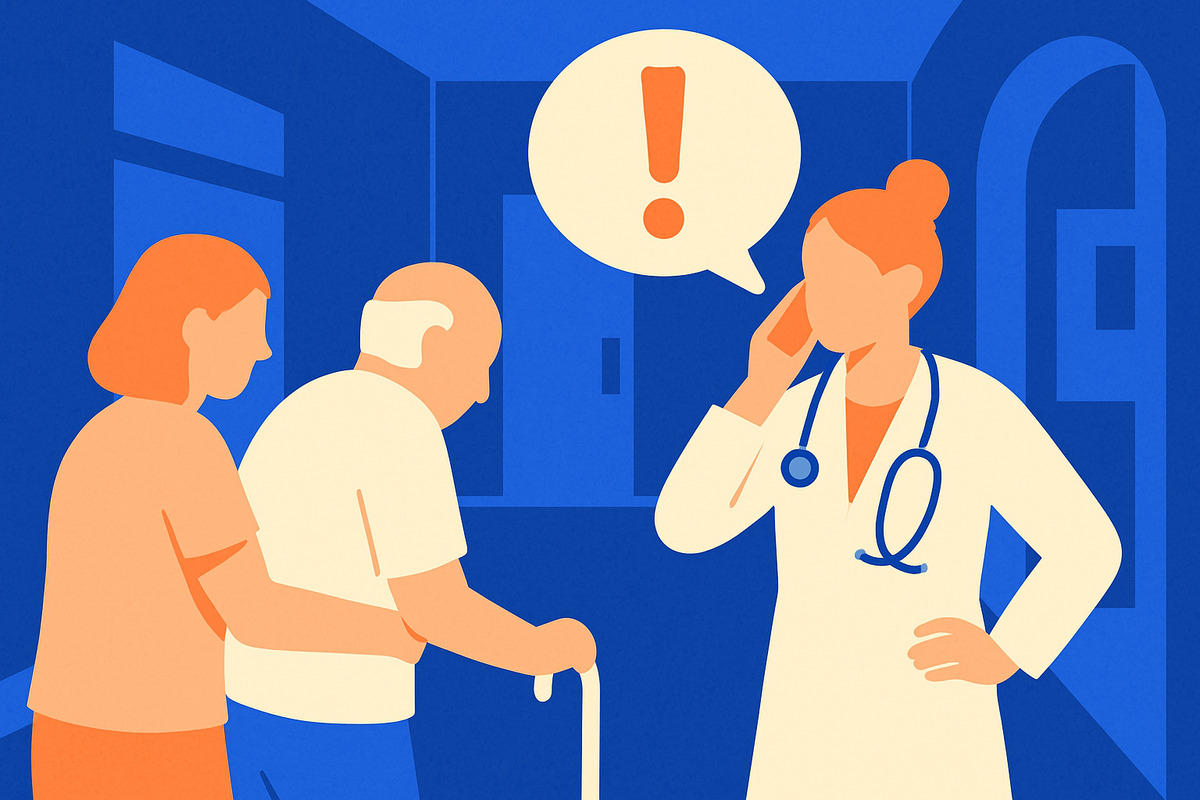
There is a triage tree with three branches available to caregivers.
Branch one is 911. Call it for the things that have to be evaluated in an emergency department right now: chest pain or pressure, sudden one-sided weakness or slurred speech, severe shortness of breath, a fall with a head strike or a possible broken bone, severe bleeding, a sudden change in consciousness, or any of the warning signs the discharge papers specifically name as "call 911." When in doubt, call. Dispatchers are trained to triage; you are not, and you should not have to be.
Branch two is the after-hours nurse line. Call it for everything that feels wrong but is not in the 911 list: a new pain, a low-grade fever, mild confusion, a missed dose, a question about whether to take or hold a medication, a wound that looks different than it did yesterday. Nurse lines are how most "I am not sure if this is serious" moments resolve safely. Save the number in every adult's phone the day of discharge.
Branch three is the follow-up provider, the home-health nurse, or the pharmacist. Call them for the slower questions: schedule changes, new symptoms over several days, a medication you are not sure why is on the list, a question about insurance coverage for a piece of equipment. These calls happen on weekdays and they happen during business hours, but they are also the calls that catch the small things before they become urgent.
A note about emergencies and AI tools: Aging Sidekick is a planning and preparation tool, not a medical adviser. For chest pain, stroke symptoms, severe bleeding, sudden weakness, or trouble breathing, call your local emergency number. For everything in between, the nurse line and the follow-up provider are still your first calls. We are not a HIPAA-covered entity — see our Consumer Health Data Privacy Notice — and we complement, not replace, your healthcare team.
Tools and templates
A few practical templates make this plan a lot easier to execute under stress. Each one is one page, designed to fit on a clipboard or a fridge.
The discharge meeting questions list (above) prints to one page if you remove the descriptions. The warning-signs page from the discharge summary is the second sheet on the fridge. The current medication list — printed, not scrolled — is the third. The after-hours nurse line and the follow-up provider phone number live on a sticky note on the front of the kitchen phone. Old technology, on purpose: in the middle of the night, paper beats searching.
We are also building a printable, gated version of the ten most important questions to ask the hospital case manager — the lead-magnet companion to this guide. When it ships, it will live behind a one-field email form on the hospital discharge intent page. Until then, the questions list above is the working draft.
A note on what helps: Aging Sidekick lets you have a calm 15-minute voice conversation, upload the discharge summary and the medication bottles, and get back a one-page daily care plan and a plain-English version of the paperwork — the same documents you would otherwise piece together from sticky notes. It is free to start. Encrypted in transit and at rest, access-controlled, and never sold. We are not a HIPAA-covered entity — see our Consumer Health Data Privacy Notice.
Sources
Frequently asked questions about hospital discharge
What is the most important thing to do before a hospital discharge?
Ask for the discharge meeting (sometimes called the care conference) at least 24 hours before the planned discharge. Bring a notebook, ask who the follow-up provider is, what the medication changes are, and what equipment will arrive at the house. If anything is unclear, that is the meeting to slow down.
What is a safe discharge?
A safe discharge is when a patient is sent home with a workable plan — the follow-up provider visit is scheduled, the medication list is reconciled, equipment is in place, and the home environment can support the level of care needed. Federal patient rights let you appeal a discharge you believe is unsafe; ask the case manager for the QIO (Quality Improvement Organization) number.
Who pays for home health after discharge?
Medicare Part A covers short-term, skilled home health (nursing, physical therapy) after a qualifying hospital stay, when the patient is "homebound" and a doctor orders it. Custodial care (bathing, meals, companionship) is usually not covered by Medicare; long-term-care insurance, Medicaid, or out-of-pocket pay covers that.
What questions should I ask the hospital case manager?
Top ten: the diagnosis in plain language, the medication list with changes flagged, the follow-up provider and appointment, equipment the house needs, the home-health agency assigned, the after-hours nurse line, the red-flag symptoms to watch for, the next two weeks of expected recovery, the rights to appeal an unsafe discharge, and a printed copy of the discharge summary.
How long after a hospital discharge is the readmission risk highest?
The first two weeks are the highest-risk window. The most common reasons for readmission are medication errors, missed follow-up appointments, and unrecognized red-flag symptoms. A printed plan with the follow-up appointment, the med list, and the symptom triggers cuts the chaos.
Can a family member be present at the discharge meeting remotely?
Yes. The case manager can call a family member on speakerphone, and many hospitals support a Zoom dial-in if you ask in advance. Long-distance caregivers should request this on day one — the meeting is too important to read second-hand.
Plan a safe discharge with Aging Sidekick
Aging Sidekick walks you through every question, document, and decision before your parent leaves the hospital — built around the specific care situation in front of you.
Start your discharge planSee how Aging Sidekick helps →