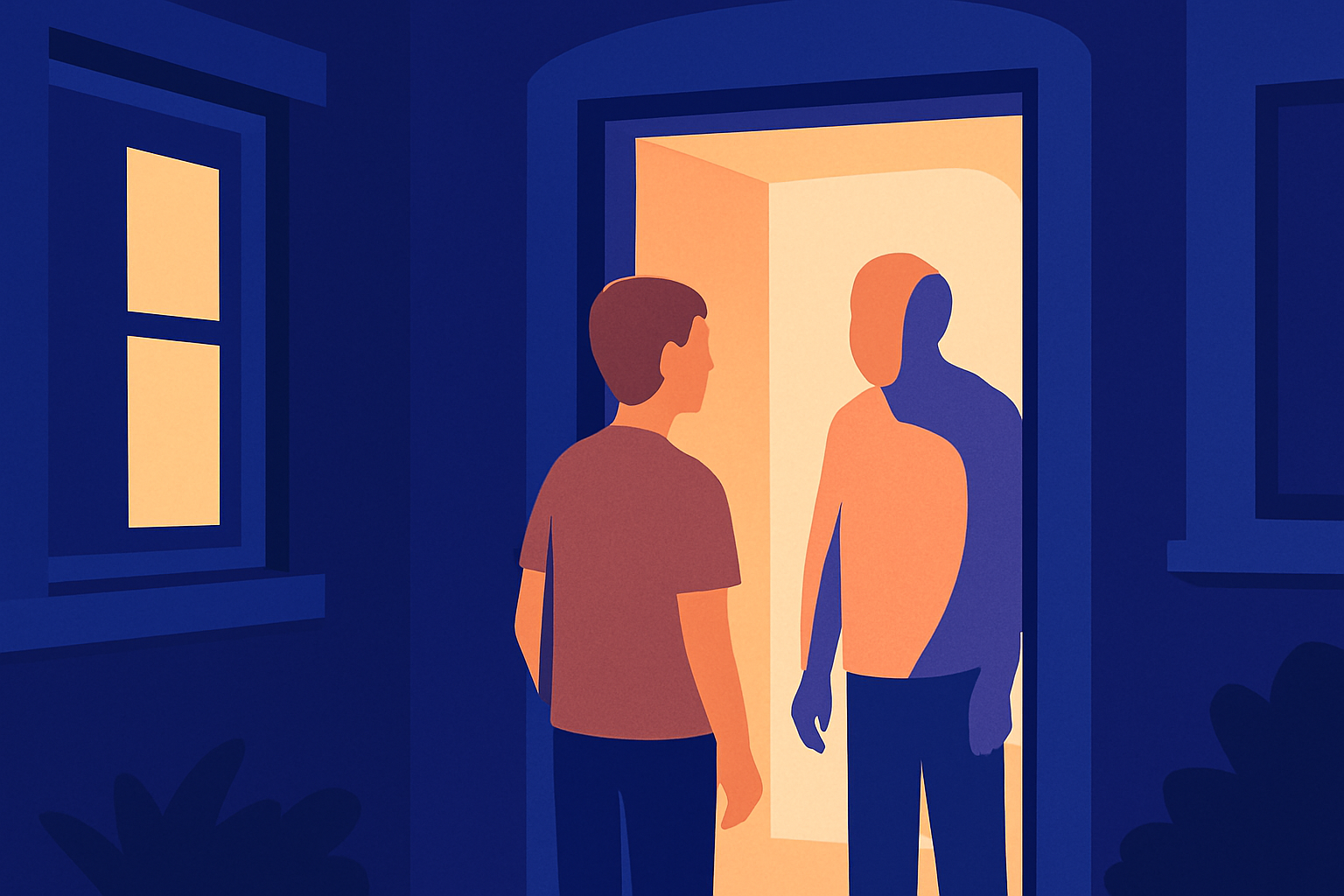
Sundowning is the name for the late-day or middle-of-the-night agitation, confusion, and restlessness that is common with dementia. One of the symptoms of dementia is losing a sense of time - time of day, hours passed, become meaningless.
Families may receive calls at 2 a.m., because their loved one doesn’t understand it’s the middle of the night. Pacing in the hallway, being convinced that it is time to go to work, or deciding it’s time to go for a nice walk in the middle of the night are all common. It is exhausting, it is common, and there are real things that can help on the next bad night.
This guide walks through what sundowning is, what is thought to be happening in the brain, the things other caregivers often try first that help, what to mention to the doctor when nothing does help, and how to keep the household safe through a sundowning episode without adding more stress.
TL;DR: Sundowning typically shows up in late afternoon, evening, or the middle of the night. Natural light, routine, food, hydration, pain, and sleep all play roles. Start with the basics: more light in the late afternoon, a consistent dinner-and-wind-down routine, a check for pain or a urinary tract infection, and a calm physical environment without overstimulation. Mention the pattern to the primary-care provider — sometimes a small medication adjustment or a check for an undiagnosed infection changes everything.
What sundowning is (and is not)
Sundowning is a behavioral pattern, not a diagnosis. It describes a real, observable change in a parent with dementia as the afternoon turns into evening: confusion that was not there at noon, agitation, restlessness, anxiety, sometimes hallucinations or delusions, sometimes a fixed conviction that it is time to leave (go to work, go home, pick up the children). The symptoms tend to peak in the late afternoon and evening and often calm in the morning.
Researchers do not have a single explanation. The leading theories involve changes to the brain's circadian rhythm (the internal clock that governs sleep and wakefulness), fatigue building over the course of the day, dim or shifting light that makes the environment harder to interpret, hunger or thirst late in the day, and a backlog of stimulation that overwhelms a brain working harder than the family can see. This is a symptom of the disease. It is not the parent choosing to make the evening difficult.
What families often try first
Experienced caregivers describe a few first-line approaches that families often find helpful. None of these are guaranteed and the right combination is different for every parent — but they are widely shared in family-support communities and are routinely mentioned by clinicians as reasonable starting points.
- More light in the late afternoonTurn on indoor lights well before sunset. Open blinds. Some families use a bright daytime lamp during the 3 to 6 p.m. window. The goal is to delay the visual cue of darkness.
- A predictable evening routineSame dinner time, same wind-down activities, same lights-down sequence. Predictability is one of the few things that consistently calms a brain that has to work harder to make sense of the room.
- Cut caffeine and naps after early afternoonA 3 p.m. coffee or a 4 p.m. nap can shift the evening sharply. Move caffeine to the morning. Cap naps at thirty minutes and not later than mid-afternoon.
- Check for pain, infection, and bathroomA urinary tract infection often presents in dementia as confusion or sudden agitation rather than the usual UTI symptoms. New or worse confusion that comes on over a day or two warrants a call to the doctor.
- A quiet, single-task environment in the eveningTurn off the television news. Limit visitors after dinner. One quiet activity at a time. Overstimulation late in the day is a known trigger for many people with dementia.
- A familiar object within reachA blanket, a photograph, a wedding ring, a familiar mug. A small, familiar object can anchor the brain.
What to do during a sundowning episode
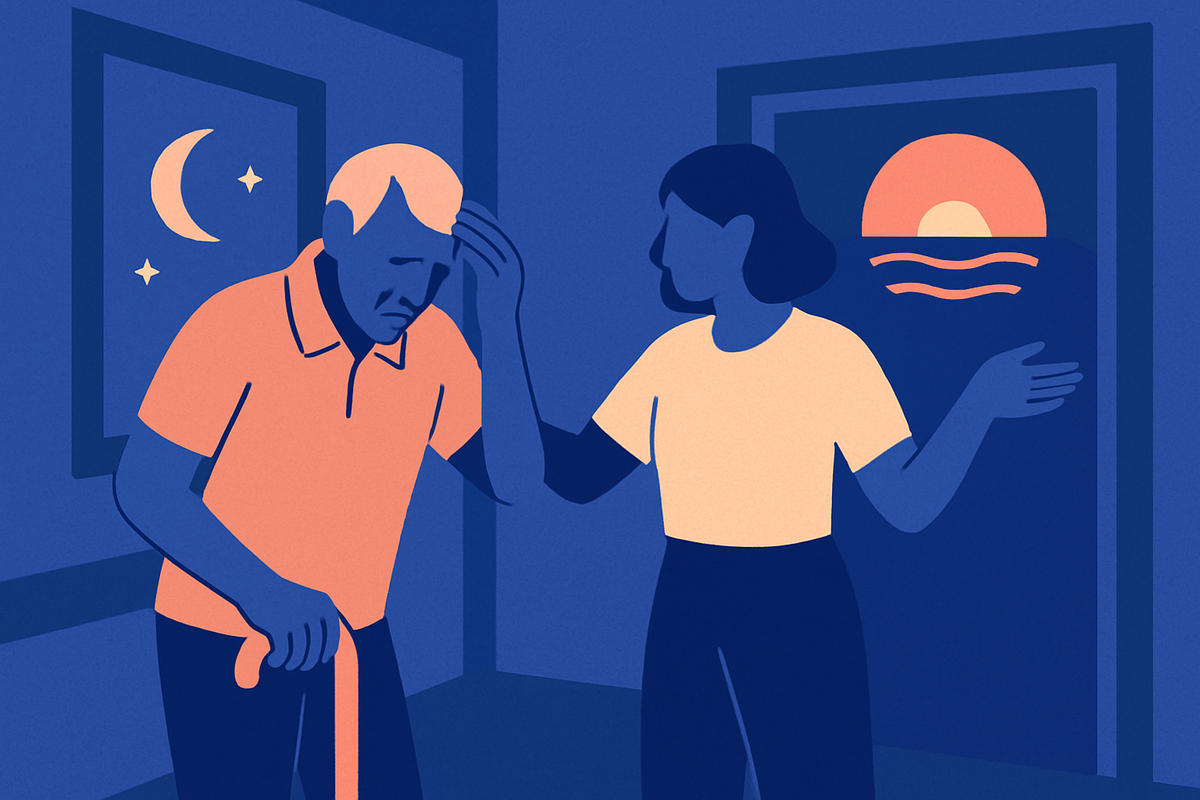
During an episode, the goal is not to argue the parent out of the experience — that almost never works and usually makes things worse. The goal is to keep the parent safe, ride the wave, and lower the temperature of the room.
A calm voice, soft light, and a small physical task help. 'Help me fold these towels' or 'come sit with me here for a minute' is sometimes enough. Reassurance about the felt need ('we will be ready to go in the morning') tends to land better than correction about the actual time ('it is the middle of the night'). The literature calls this 'therapeutic fibbing'; many families just call it letting the parent be where they are.
When to mention it to the doctor
Sundowning is worth mentioning at every routine dementia visit even if it has not yet appeared. When it does, the doctor will want to know the pattern — when it started, what time of day it shows up, how long it lasts, whether anything changed in the household before it started. A two-week diary of evenings, with a one-sentence summary each night, is the single most useful thing to bring to that appointment.
Two situations warrant a sooner call. The first: a sudden change in behavior or alertness that came on over a day or two — that pattern often points to an infection or a medication issue, not necessarily a progression of the dementia. The second: episodes that are unsafe — falls, wandering out of the house, aggression that is harming other people. The first call is to the primary-care provider; in an emergency, the local emergency number.
The sundowning conversation often surfaces alongside hallucinations or visual disturbances — which can be a feature of Lewy body dementia specifically. For the type-by-type primer, see Alzheimer's, vascular, Lewy body, frontotemporal: how to tell them apart. The middle-of-the-night ER trip is also worth preparing for in advance — for the pre-packed bag families keep on the closet shelf, see What to put in a dementia 'go-bag' for ER visits.
Caring for the caregiver
Sundowning is harder on the caregiver than almost any other dementia symptom because it interrupts sleep. Sleep loss erodes patience, judgment, and resilience faster than the family realizes. A caregiver who has been the only night person for two weeks is a caregiver who is no longer making careful decisions — that is a fact, not a judgment.
If sundowning is consuming the night, ask for relief by name. A sibling who can take two nights a month. A respite-care service for one overnight a week. An adult-day program that runs late afternoons (some specifically target the sundowning window). The Eldercare Locator (1-800-677-1116) can name the local programs. Or, contact your local Area Agency on Aging. The Alzheimer’s Association is also a great resource for caregiver support and training. No single family is supposed to do this alone.
For the broader first-month playbook this conversation feeds into, see The First 30 Days After a Dementia Diagnosis. For the longer pillar of related guides, the Dementia & Alzheimer's hub has the full set.
A note on what helps: Aging Sidekick can help you turn a two-week sundowning diary into a one-page summary to bring to the doctor — built from a fifteen-minute voice intake. Free to start. For sudden behavior changes that may signal an infection or medication problem, call the primary-care provider. For unsafe situations, call your local emergency number.
Get a dementia care roadmap
Aging Sidekick assesses your parent's specific situation across 18 dimensions and outputs a Life Plan you can act on — for the first 30 days and beyond.
Start your care roadmapSee how it works for dementia families →