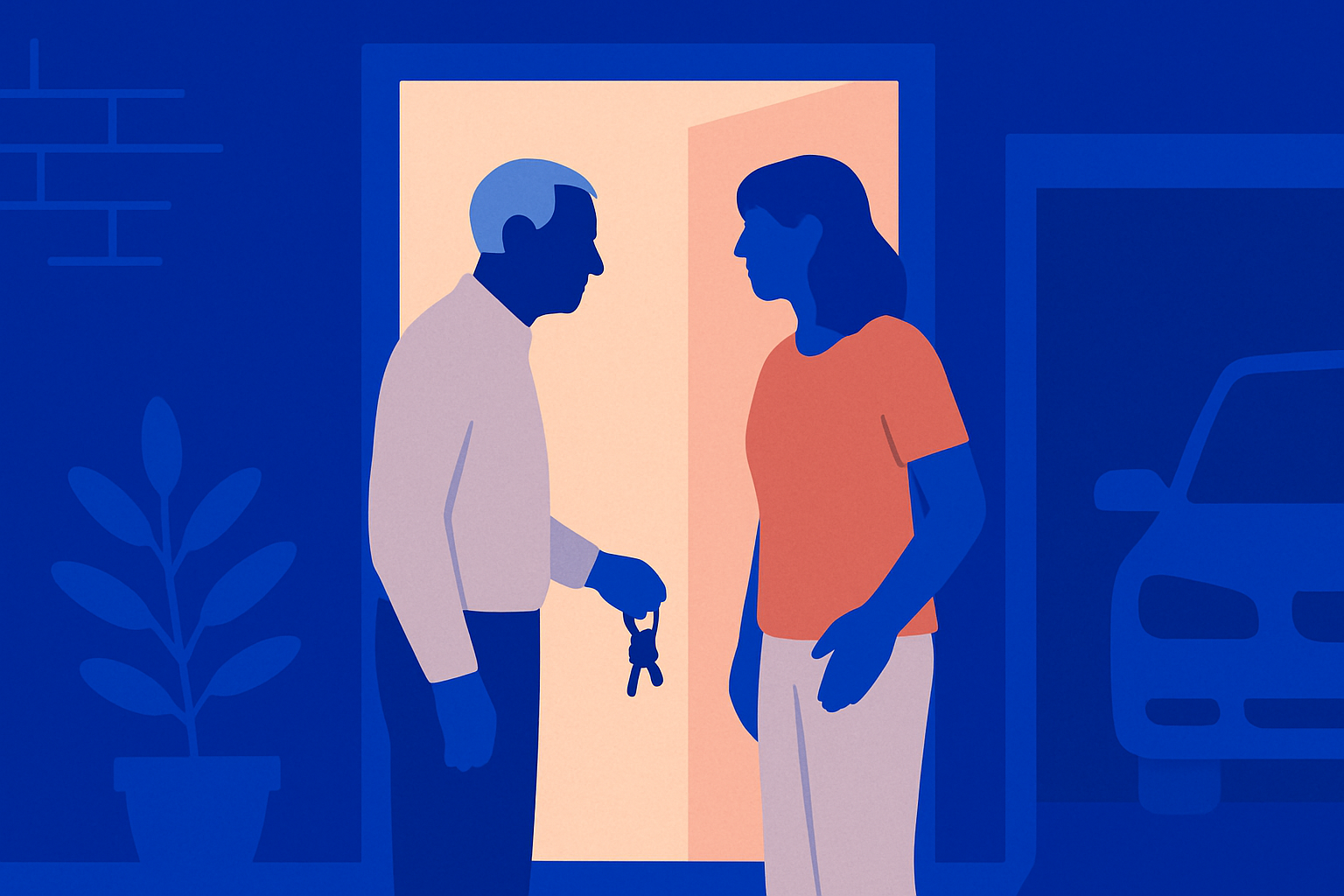
Driving is one of the hardest conversations after a dementia diagnosis. The car symbolizes independence, identity, and routine all bundled into one set of keys. The conversation is not really about driving — it is about who the parent is, and who the family is asking them to become. Most families dread it; but it typically cannot be avoided for long.
This guide is not a script for getting the keys away. It is a guide to what to consider, what other families have tried, the formal evaluations that exist, and how to keep the conversation about safety without making it about the parent. There is no version of this that is easy. There are versions that are kinder.
TL;DR: A dementia diagnosis does not automatically mean the parent has to stop driving immediately. Early-stage dementia and safe driving may coexist for a while. The questions that matter are about behavior on the road, not just the diagnosis on the chart. A professional driving evaluation (from an occupational-therapy driver-rehab specialist) is the most objective input the family can get. Plan early for the day driving ends, even before it has to — the alternative transportation has to be in place when the keys go away.
Why this is so hard
The car is a stand-in for a lot of things. It is how the parent gets to coffee with their oldest friend, to the church they have gone to for forty years, to the doctor, to the grocery store, to the cemetery. It is the daily reminder that they are still the adult in the house. Asking a parent to stop driving is asking them to lose all of that on a single afternoon. The grief is real, even when the family is right.
The family carries the other side: the knowledge of what happens if a parent with dementia hits a pedestrian in a crosswalk because they mixed up the brake pedal with the gas pedal. There is no version of that future the family can live with — and there is no version of taking the keys that feels good. Holding both halves is what makes this the conversation no one wants to have.
What to watch for
The questions that matter are about behavior on the road, not the diagnosis on the chart. The Alzheimer's Association and several state DMV resources list signs that often warrant a closer look. The list below is the shorthand families and clinicians often use; none of these on its own is conclusive, but two or three together usually warrant a formal evaluation.
- Getting lost on familiar routesNot a one-off detour — a parent who finds the route to a long-known destination has become disoriented more than once.
- New near-misses or minor incidentsA scrape on the bumper that was not there last week. A neighbor mentioning a close call at the four-way stop. Small body-shop receipts that did not used to happen.
- Confusion at intersections or with signageHesitating at a four-way stop in an unusual way. Misreading the signs. Following too closely or driving notably below the speed limit.
- Slow reactions to surprisesA child runs into the street; the parent's foot moves later than it used to. A driver merges in front; the parent does not brake in time.
- Anger or anxiety while drivingNew road rage where there was none. New stress about driving routes the parent used to drive easily.
- Other adults in the family avoiding the passenger seatOften the quietest signal in the house — a spouse who used to ride along now suddenly always drives.
The professional driving evaluation
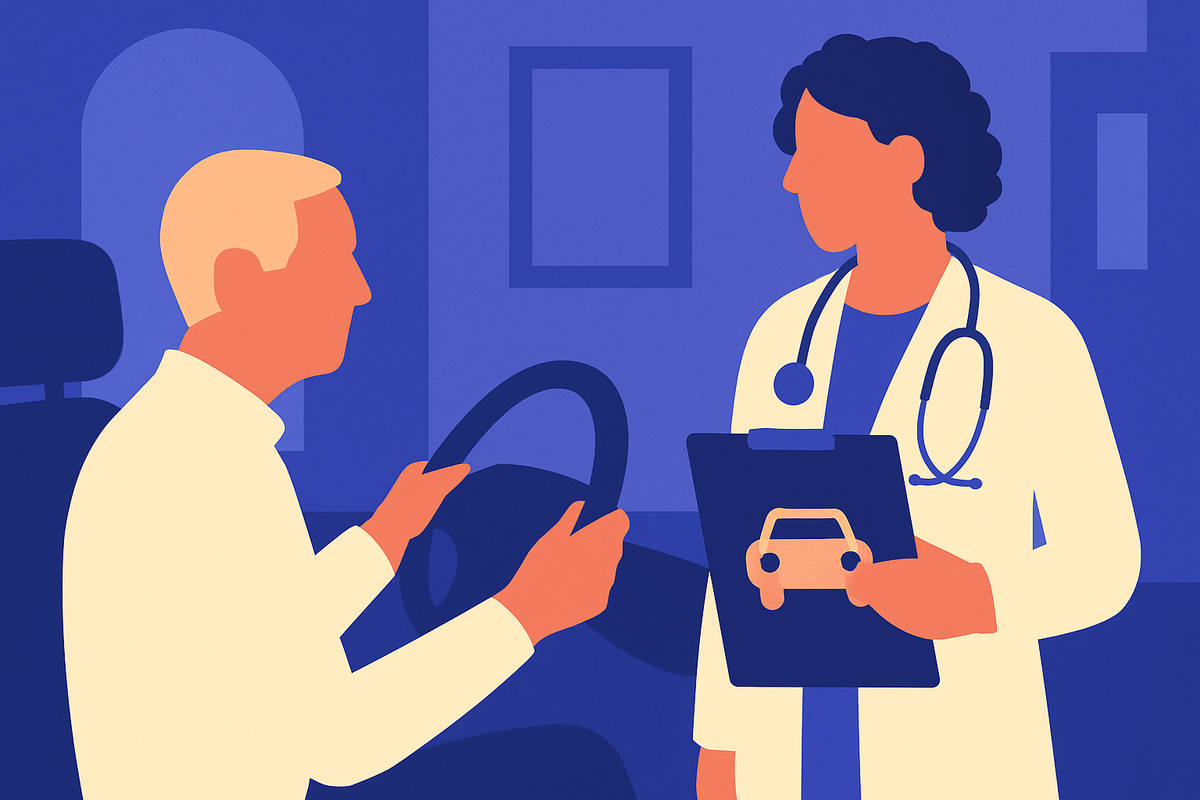
The most objective input a family can get is a professional driving evaluation — typically done by an occupational therapist with a Certified Driver Rehabilitation Specialist (CDRS) credential. The evaluation includes a clinical component (vision, attention, reaction time, judgment) and an on-road component in a dual-control car. The cost varies (often $300 to $700) and is sometimes partially covered by insurance; in some states, the AAA Foundation maintains a referral list.
The advantage of a professional evaluation is that the result lands with the parent from a neutral expert, not from the adult child. A family that has tried to take the keys directly often hits a wall; the same family with an evaluation report in hand often gets a real conversation. Some parents will pass — and that is its own kind of useful, because it buys the family planning time without immediately ending driving.
Conversations that other families have tried
There is no single conversation that works. Most families end up trying several, and most families need more than one round. The patterns below are what surfaces most often in family-support communities.
Some families do the gradual conversation — start by limiting driving (no nighttime, no highways, no unfamiliar areas), then evaluate again in three months. Some families let a trusted third party deliver the message — the primary-care provider, a longtime friend, sometimes the parent's adult grandchildren. Some families work the practical side first — sell the second car, get the parent comfortable with a ride service or a regular neighborhood driver, then have the conversation when the alternative is already in place.
When the parent will not stop
Some parents will not stop driving voluntarily. The family then has to decide what level of action they are willing to take. Options range, from gentle to firm: disabling the car quietly (a missing battery cable, a 'dead' starter that the mechanic confirms in writing), hiding or relocating the keys, selling the car, reporting unsafe driving to the state DMV (most states accept reports from family members and from physicians, sometimes anonymously), and in some states, a physician-initiated medical-condition report.
Each option has costs. Each option is one some families have used and others have not. The right level depends on the parent's actual driving, the family's read of the risk, and the state's rules. There is no universally right answer here — only versions that are safer and versions that are kinder, and usually the family is trying to find the one that is both.
The conversation often surfaces alongside the broader question of what the parent does and does not accept about the diagnosis. For the related piece on talking to a parent who will not engage with the diagnosis at all, see How to talk to a parent in denial about their diagnosis. The driving conversation also intersects with the question of capacity for legal documents — for the broader paperwork timing, see Why POA needs to happen before, not after, the diagnosis.
Planning the day after
The day the keys go away is also the day a new transportation plan begins. The plan is bigger than 'we will drive Mom around.' It includes the grocery store, the doctor visits, the coffee with old friends, the small errands that have nothing to do with caregiving and everything to do with being a person. Without that plan, the parent loses driving and loses social life at the same time — and the depression that follows hurts everyone.
Most communities have at least three options worth combining. A volunteer-driver service (sometimes through the Area Agency on Aging or a local nonprofit); a paid ride service the parent can use independently (Uber, Lyft, GoGoGrandparent for parents without smartphones); and a once-a-week standing ride from a family member or neighbor for the bigger trips. The Eldercare Locator (1-800-677-1116) is the place to start.
For the broader first-month playbook this conversation feeds into, see The First 30 Days After a Dementia Diagnosis. For the longer pillar of related guides, the Dementia & Alzheimer's hub has the full set.
A note on what helps: Aging Sidekick can help you turn the driving question into a one-page plan organized by topic — what to watch for, the evaluation referral, the alternative-transportation map, and the conversation script — built from a fifteen-minute voice intake. Free to start. We complement, not replace, your healthcare team.
Get a dementia care roadmap
Aging Sidekick assesses your parent's specific situation across 18 dimensions and outputs a Life Plan you can act on — for the first 30 days and beyond.
Start your care roadmapSee how it works for dementia families →